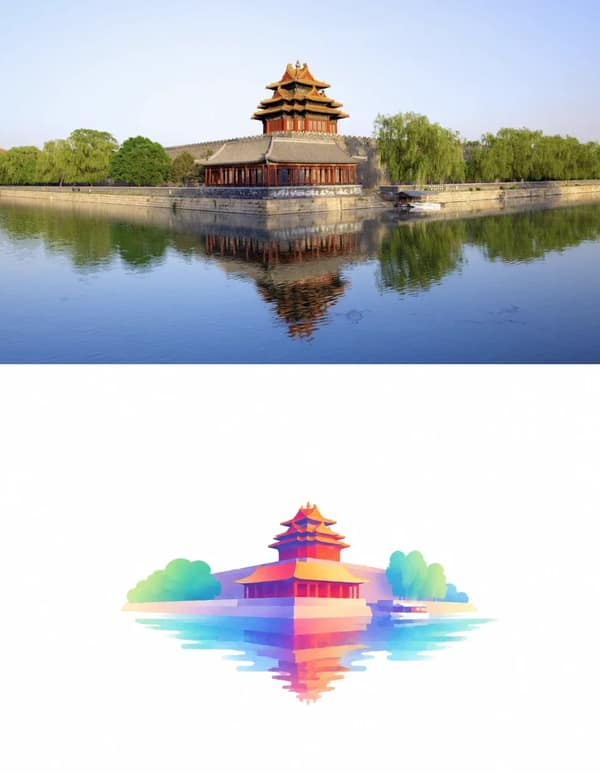
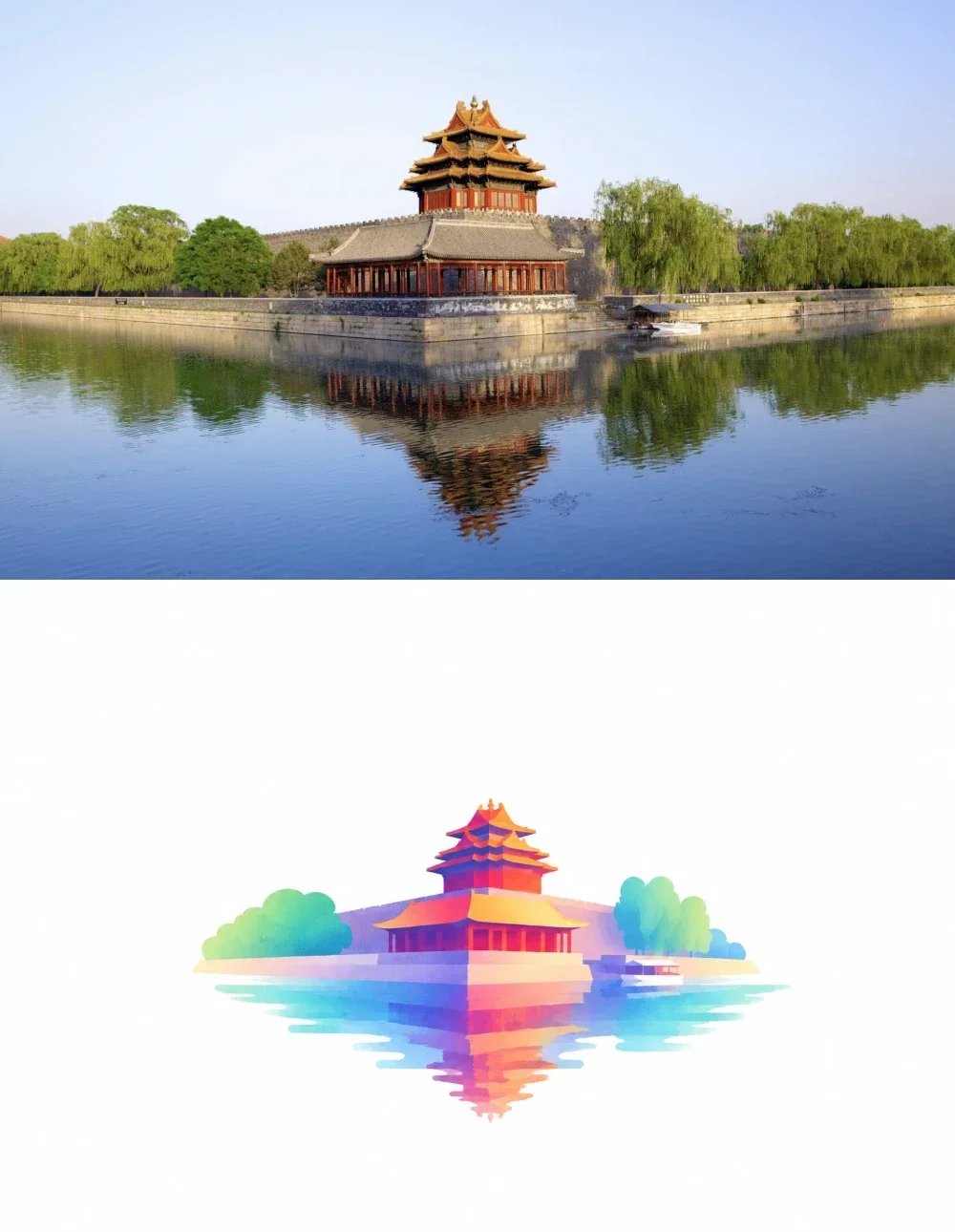
Based on the [original photo] I uploaded, recreate the photo as a minimalist gradient illustration.
The focus is not on fully rendering the photo, but on significantly refining, reducing, and summarizing its content, keeping only the most memorable visual elements of that moment.
Preserve the core content of the original photo:
- Subject identity characteristics
- Subject's pose, movement, and orientation
- Spatial relationships between subjects
- The most recognizable scene elements
- The general composition and narrative feel of the original photo
But actively delete most realistic details; do not fully redraw the entire photo.
Image processing principles:
Transform the real photo into:
Abstract symbols, deconstructed style, minimalist gradient illustration, pure wireless vector art (completely free of black lines, outlines, or strokes). Simplify the subject's facade into 2–3 purely asymmetrical vector planes, presenting polygonal facets. Use smooth, glowing diffuse mesh gradients, with colors transitioning softly between vibrant magenta–coral–amber and translucent cyan–teal–periwinkle blue. Inside the color blocks, present a delicate stippled texture, with sharp, distinct edges.
Subject treatment:
Do not draw people, animals, or subjects too large.
Significantly reduce the subject's size, placing it in the lower-middle or slightly below-center area of the frame, making the subject feel like a small memory fragment.
Do not finely depict facial features; do not create a beautiful, detailed portrait illustration.
Maintain recognizability through silhouette, movement, hairstyle, clothing, and posture.
For animals, preserve breed, fur color, posture, and silhouette, but still keep them highly simplified.
Scene treatment:
Keep only 1–3 of the most recognizable scene elements.
For example: trees, mountains, grassy slopes, sea surface, boats, churches, building silhouettes, clouds, windows, railings, stones, roads, etc.
Do not fully detail the scene; only summarize it with a few lines and a few color blocks.
Do not retain the entire complex background.
Color expression:
Colors transition softly between vibrant magenta–coral–amber and translucent cyan–teal–periwinkle blue. Inside the color blocks, present a delicate stippled texture.
Composition and layout:
The background must be white.
The main illustration subject should occupy only a small area of the frame.
Leave ample white space around the edges, especially noticeable blank space at the top and on the left and right sides.
Do not add text.
Final aesthetic:
The image should present:
A flat, facade view, graphic design style.
Strict restrictions:
- Do not draw the person as a delicate, beautiful portrait illustration.
- Do not retain too many facial details.
- Do not draw too many clothing folds.
- Do not fully redraw the background.
- Do not carefully render windows, leaves, buildings, or the ground.
- No realistic watercolor.
- No impasto.
- No commercial illustration feel.
- No refined anime style.
- No childlike cartoon style.
- Do not fill the frame.
- Do not make it complex.
- No "photo-to-painting filter" effect.
**The final result must feel like: from a photo, only the most memorable moment is extracted, recorded with vector gradient color blocks on a travel journal page with white space. Compress the original photo into a minimalist small-scene memory; do not create a complete illustration. Delete 70%–85% of the details, keeping only the most essential subject and scene symbols.**